Getting Around Istanbul's Historic Peninsula
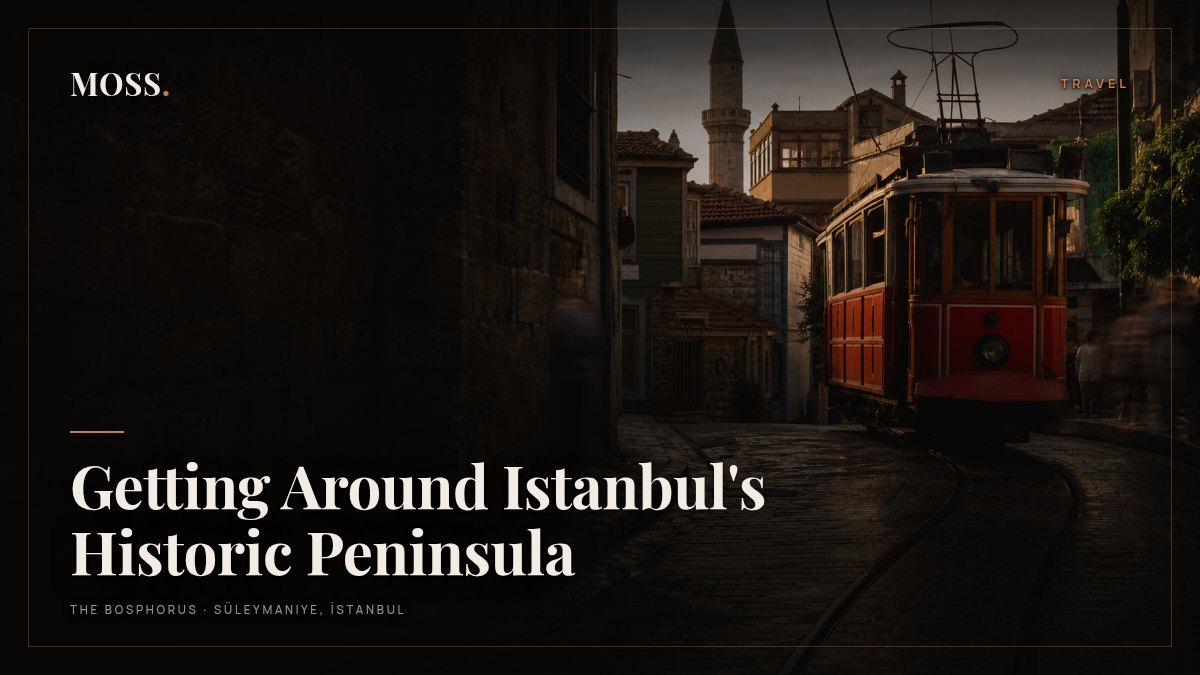
Getting around Istanbul's historic peninsula (the old core of the city above the Golden Horn, the district of Fatih) is mostly a matter of one tram line, the occasional ferry, and your own two feet. The short answer for first-time visitors: buy an Istanbulkart (the city's rechargeable transit card), ride the T1 tram for the long stretches between the headline sights, and walk the rest. The peninsula is compact, the streets are old and steep in places, and the best of it reveals itself on foot.
What is the Istanbulkart and do I need one?
The Istanbulkart is a single contactless card that pays for almost everything that moves: trams, buses, the metro, the ferries, and the funiculars. You tap on as you board. It is cheaper per ride than a paper ticket, and one card can pay for several people, so a couple or a small group can share.
Pick one up from a kiosk or a machine at any tram stop, airport, or major station, then top it up with cash or card. A few notes that save confusion:
- Keep a little more credit on the card than you think you need. Topping up between rides is possible but slows you down.
- The same card works across the whole network, so you never need separate tickets for the tram and the ferry.
- Tap on every time you board, including transfers. The system applies a small discount on quick connections.
How does the tram work on the peninsula?
The line you want is the T1 tram. It runs the spine of the old city, linking Sultanahmet, the Grand Bazaar area, Eminönü by the water, and on across the Galata Bridge toward Karaköy. For a visitor staying among the historic sights, it covers most of the long distances you would not want to walk in the heat.
It is simple to use. Stops are clearly named, the trams come often, and the route is a straight line, so you cannot get badly lost. The carriages fill up around the busy sights, so expect to stand at peak times. For shorter hops between neighbouring landmarks, walking is usually faster than waiting, since the stops sit close together.
Are the ferries worth taking?
The ferries are one of the quiet pleasures of Istanbul, and on the peninsula they are genuinely useful as well as lovely. From Eminönü, at the foot of the old city by the Galata Bridge, boats cross the Golden Horn and the Bosphorus to the other shores. Even a short crossing gives you the city from the water, with the domes and minarets stacked up the hillside behind you.
You pay with the same Istanbulkart, you board without a fuss, and you sit out on deck with a glass of tea if the weather is kind. For getting a feel of how Istanbul is built around water rather than roads, half an hour on a ferry teaches you more than any map. It is also the gentlest way to arrive somewhere, which suits the unhurried pace the old city rewards.
How do I reach Süleymaniye?
Süleymaniye sits on one of the peninsula's hills, a little above and away from the main tram line, which is exactly why it stays quiet. There is no tram stop at its door. The usual approach is to ride the T1 to a stop near the Grand Bazaar or down by Eminönü, then climb the old streets up the slope. It is a short walk, but an uphill one, through lanes that grow calmer the higher you go.
That last stretch on foot is part of the appeal. You leave the crowds behind within a few minutes, the noise drops, and the great mosque rises ahead of you. If you would rather pair the climb with a reason to pause at the top, our guide to walking the historic peninsula maps a route that ends with a view, and the wider Süleymaniye visitors' guide covers what to see once you arrive.
Walking the old city: a few honest tips
Walking is the real way to know the peninsula, but the ground is uneven and often steep, so a few small habits help.
- Wear shoes you trust on worn stone and cobbles. The old lanes are not made for smooth soles.
- Carry water and plan around the heat. In summer, do the climbing early or late and save the middle of the day for shade, tea, or a long meal.
- Let yourself get a little lost. The side streets of Süleymaniye and the bazaar quarter are where the city feels most itself, and you are rarely more than a few minutes from a landmark to reorient by.
- Build in stops. The peninsula is not large, but it asks to be taken slowly, with pauses for tea and a view rather than a march from sight to sight.
Once you have the tram, a ferry now and then, and a card in your pocket, the historic peninsula opens up easily. If anything, the harder skill is slowing down enough to enjoy it, which is its own small art, explored in our piece on Istanbul for slow travellers.
When the climb is done and you are ready to stop moving for a while, Moss Lounge the Bosphorus sits up in Süleymaniye, on Fetva Yokuşu, with the great mosque on one side and the Bosphorus and Golden Horn on the other. Adem Özen opened it in 2019 and runs it as a home rather than a restaurant, so it is an easy place to land after a morning on your feet: a long table, endless çay (Turkish tea), and a terrace that earns the walk up the hill.