Why a Turkish Breakfast Takes Hours (and Why That's the Point)
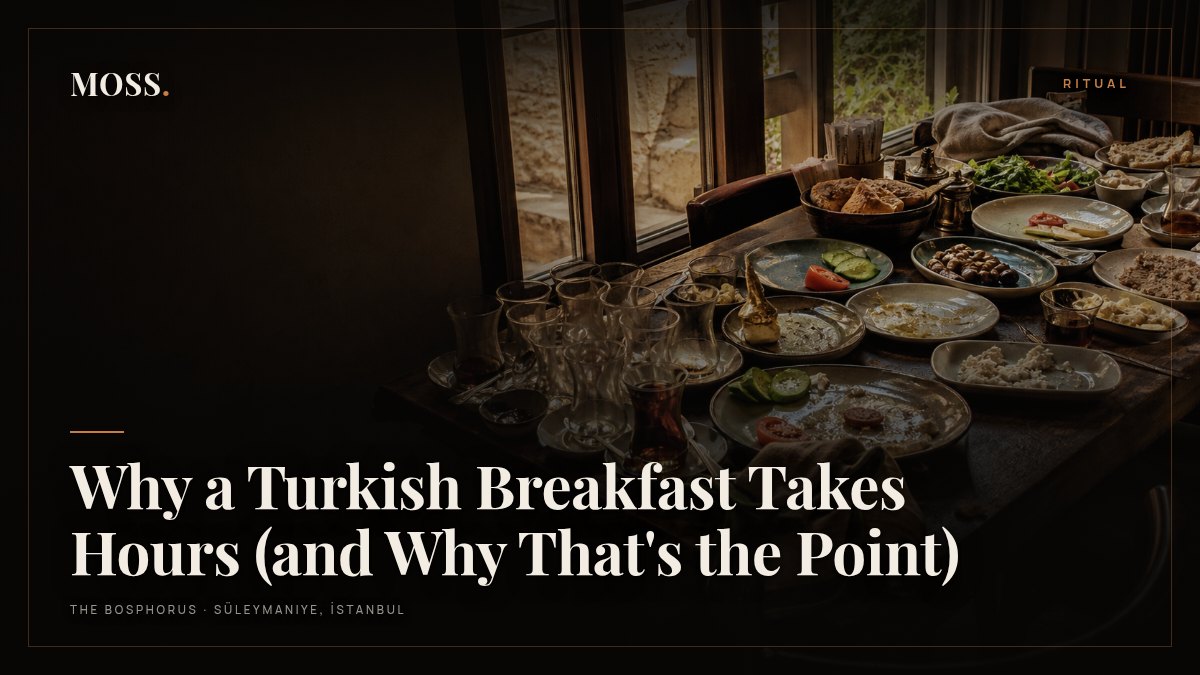
A Turkish breakfast often takes two hours or more, and that slowness is the point, not a flaw. People ask why a Turkish breakfast (in Turkish, kahvaltı) takes so long, and the answer is built into the meal itself: there is no single main dish to rush toward, no set order to follow, and dozens of small plates to graze across while the tea keeps coming. It is a meal designed around conversation rather than fuel, a deliberate pause held onto in one of the world's faster cities.
Why has the breakfast no single main course?
Most breakfasts are built around one centrepiece you work toward and finish: a plate of eggs, a bowl of cereal, a pastry and a coffee. A Turkish breakfast removes that centre entirely. Instead the table fills with many small dishes set out at once, cheeses, olives, tomato and cucumber, eggs, jams, honey, warm bread, and you move between them in no fixed sequence.
Without a main to chase, there is nothing to signal that the meal is over. You taste a little of one thing, return to another, build a small bite, then reach for the tea. The structure has no finish line, so the meal naturally stretches. The variety that looks generous on the table is also what keeps everyone seated: there is always one more thing to try.
How does the table hold a conversation together?
The shared, grazing format does quiet social work. Because everyone is reaching across the same plates rather than guarding their own, the table stays connected. Hands cross, dishes get passed, and the act of eating becomes something you do together rather than in parallel. The breakfast is less a meal you attend and more a table you sit around.
The tea is the engine of this. Brewed strong and refilled again and again, çay (Turkish black tea) keeps the table in motion long after the food has slowed. An empty glass is an invitation for another, and each refill quietly extends the conversation by another quarter hour. You do not get up because there is always more tea coming and someone is still mid-sentence.
- No courses: everything arrives at once, so no one is waiting on the next plate or signalling the end.
- Shared plates: reaching across the table keeps everyone in the same conversation.
- Endless tea: the refills carry the meal past the food and into talk.
- No clock: the format has no built-in finish, so the morning sets its own length.
What makes the weekend serpme so unhurried?
The slowness reaches its fullest form at weekends, with the serpme kahvaltı (a “scattered” breakfast where small plates cover every inch of the table). Families and friends gather late in the morning, order the full spread, and settle in for the long haul. Plates keep coming until there is barely room left, and the meal becomes the whole occasion rather than a start to it.
This is the breakfast people protect from the working week, when mornings are rushed and a simit eaten on the move has to do. The weekend table is the correction: a deliberate, hours-long sit-down with no plan beyond being there. The richest part of the meal, the honey and clotted cream, usually comes near the end of this long arc, a sweet reward for not hurrying. Our piece on the honey and kaymak ritual explains why the sweetest bite is saved for last.
Why is the ritual the occasion, not the fuel?
In a city as fast as Istanbul, sitting still for two hours is its own statement. The breakfast is not really about getting fed, which a single plate could manage in minutes. It is about claiming a stretch of unhurried time with the people across the table, a pause the rest of the day rarely allows. The food is the reason to gather, and the gathering is the point.
That is why the meal resists being sped up. To eat a Turkish breakfast quickly is to miss what it is for. The whole shape of it, the shared plates, the absent main, the endless tea, exists to slow you down and keep you seated. If you want to see how the full table is built and how Istanbullus move across it, our guide to the traditional Turkish breakfast lays out every dish and the rhythm that ties them together. The slowness is the gift, not the wait.
A long, unhurried breakfast in Süleymaniye
If you would like to give a morning the time it deserves, Moss Lounge the Bosphorus sits in Süleymaniye, on the historic peninsula, with a terrace looking over the old city and the water. Adem Özen, who opened it in 2019, lays out a generous Turkish breakfast and keeps the tea coming, treating the place as a home rather than a restaurant. It is a calm place to let the meal stretch, refill the tea, and have nowhere else to be.