The History of Nargile in Ottoman Istanbul
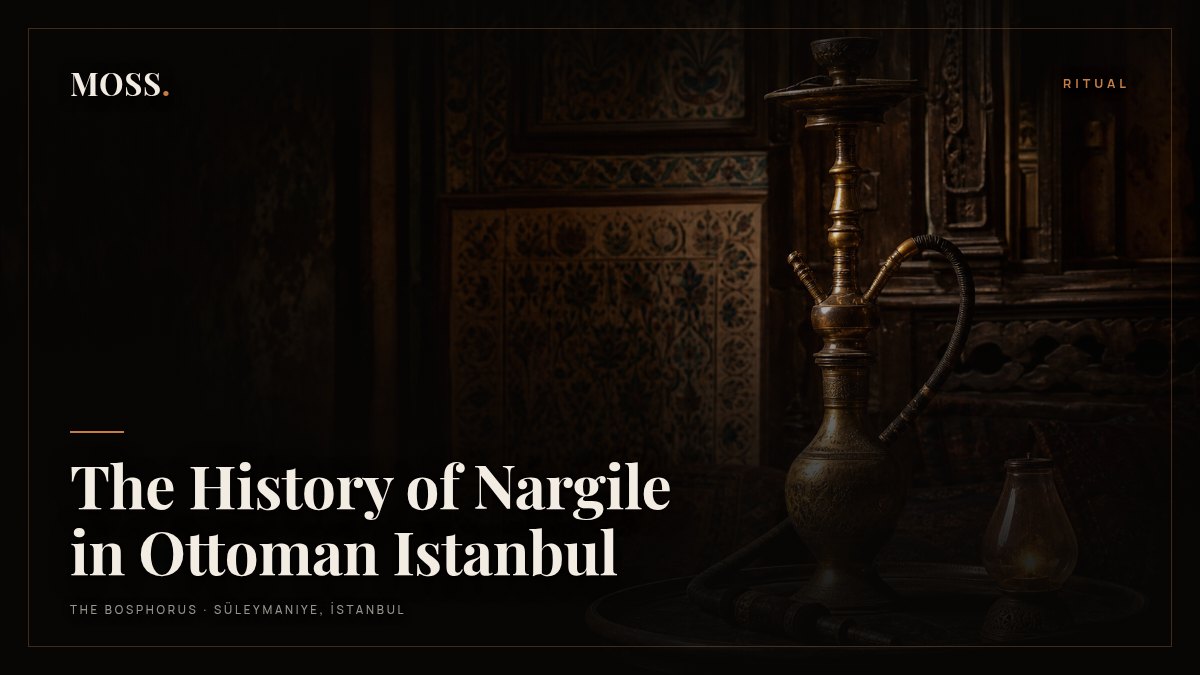
The history of nargile (the Turkish water pipe, known elsewhere as the hookah) in Ottoman Istanbul is the story of how a foreign device became one of the city’s most enduring social habits. The short version: the water pipe reached Ottoman lands by roughly the seventeenth century, found its natural home in the coffeehouse, survived several rounds of official disapproval, and settled into everyday life as a companion to long conversation. For three centuries it set the pace of Istanbul’s social hours. This is a look at how that happened and what survives of it now.
How did the nargile reach Ottoman Istanbul?
The water pipe arrived in Ottoman territory from the east, part of the long traffic of goods, people, and habits that moved across the empire’s trade routes. By the seventeenth century it was established in Istanbul, no longer an exotic curiosity but a familiar object in the hands of ordinary people.
Two things made it spread. First, it travelled alongside another newcomer that was reshaping the city at the same time: coffee. The two arrived into the same social moment and grew up together, the cup and the pipe becoming a matched pair. Second, the device suited the temperament of the place. It rewarded sitting still and talking, which was already how the city liked to spend its evenings. The nargile did not have to create a habit. It slotted into one that was waiting for it.
Why was the coffeehouse the heart of nargile culture?
The kahvehane (the Ottoman coffeehouse) was where the nargile most belonged. These were the social engine of the old city, rooms where men gathered to drink coffee, read, listen to storytellers, argue over the news, play backgammon, and pass a shared pipe between them. The nargile was not a sideshow there. It was part of the furniture of public life.
What the coffeehouse offered was time, and the nargile asked for exactly that. A pipe took a while to prepare and longer to enjoy, so to order one was to announce that you were staying. It anchored a table. Around it, conversation could stretch for hours without anyone feeling they had outstayed their welcome. The rhythm of those rooms, unhurried, talkative, faintly hazed with smoke, is the rhythm the nargile carried with it everywhere it went.
These gatherings mattered beyond leisure. The coffeehouse was one of the few places where people of different stations mixed and where opinion formed and spread. The pipe sat at the centre of that exchange, a small shared object around which a very public kind of talk took place.
Was nargile ever banned in the Ottoman Empire?
Yes, more than once, and the bans tell you how seriously the authorities took these gathering places. At various points Ottoman rulers cracked down on coffeehouses and on smoking, sometimes with great severity. The objection was rarely the smoke itself. It was the rooms, and the loose, unsupervised talk that filled them.
A place where men sat for hours exchanging views was, to a watchful state, a place where discontent could gather. So the crackdowns came in waves. Coffeehouses were closed, smoking was forbidden, and at the harshest moments the penalties were real. Yet the habit always returned. Each ban eventually loosened, the rooms reopened, and the pipe came back to the table. The cycle of prohibition and revival ran through Ottoman history without ever breaking the custom for good. People wanted the company, and the nargile was bound up with it.
What did the nargile mean in everyday Ottoman life?
Beyond the coffeehouse, the nargile worked its way into the texture of ordinary days. It was a fixture of hospitality, offered to guests as a mark of welcome, and a feature of leisure across many walks of life. To share a pipe was to share time, and time given freely was the real courtesy.
It also carried a certain dignity. Preparing a good nargile was a craft, the charcoal and the tobacco tended with care, and enjoying one well meant doing so slowly, without hurry or show. The pipe stood for a way of being in company that valued patience over speed. That spirit, more than any particular blend or ritual, is what the object really represented in the old city.
What survives of that history in Istanbul today?
What survives is the spirit, not the empire. The grand era of the coffeehouse has passed, but the nargile is still part of Istanbul’s evenings, and the thing it asks of you has not changed. To sit with one is still to slow down, to settle in, to give the table your time. Travellers who try it are meeting a custom with deep roots, even if the setting around it is new.
If you would like a fuller, practical sense of the pipe itself, our beginner’s guide to nargile covers how it works and how to enjoy a first session, and you can read more about nargile as a social ritual to understand why it has always been about company rather than smoke.
At Moss Lounge the Bosphorus in Süleymaniye, that old rhythm has a place to land. Adem, the host, keeps a calm terrace above the historic peninsula where a nargile, a glass of çay (Turkish tea), and an unhurried evening over the water still mean what they always have. It is a small continuation of a very long habit.