A Guide to Turkish Desserts Beyond Baklava
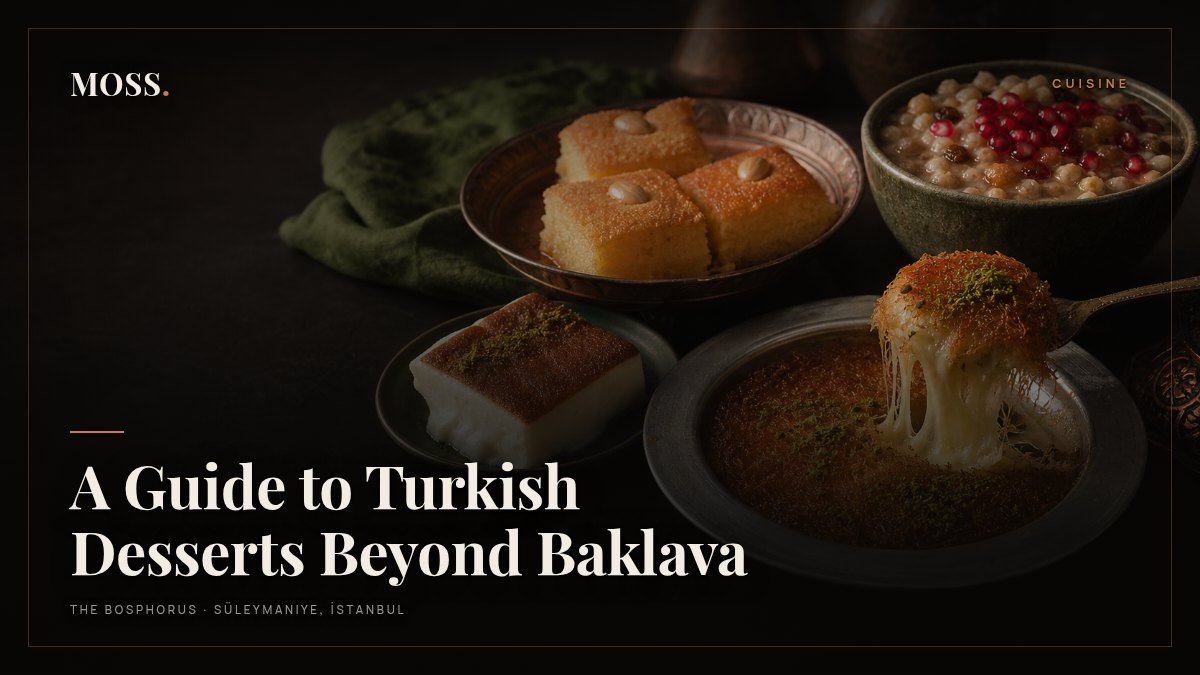
Turkish desserts go far beyond baklava. The short answer for anyone asking is this: Turkey has two broad families of sweets, the syrup-soaked pastries like baklava and künefe, and the gentler milk puddings like sütlaç and kazandibi, with fried lokma, cooling dondurma and chewy Turkish delight rounding out the table. Some are warm and rich, meant for a slow late hour. Others are light and milky, the kind you finish a long meal with. Knowing the difference helps you order well, especially at the end of an evening in Istanbul.
What is künefe, and why do people love it?
Künefe is the warm centrepiece of Turkish desserts: shredded pastry (kadayıf, fine threads of dough) layered around a mild stretchy cheese, baked until the top crisps to deep gold, then soaked in light syrup and served hot. It usually arrives crowned with crushed pistachio. The pull of it is the contrast, a crisp, syrupy crust over a soft, faintly salty cheese centre that stretches as you lift the spoon.
It is best eaten the moment it lands, while the cheese is still molten. Künefe is a dessert you order to share and eat without delay, often late, often with Turkish coffee or tea alongside to cut the sweetness.
What are the classic Turkish milk puddings?
Alongside the syrupy pastries sits a quieter family: Turkish milk puddings, gentle, cooling and far less sweet. These are the everyday desserts, the ones that close a heavy meal without weighing you down. The ones worth knowing:
- Sütlaç: rice pudding, slow-cooked with milk and a little rice, often baked so the top browns. Served cold, dusted with cinnamon. Simple and comforting.
- Kazandibi: literally “bottom of the pot”, a milk pudding deliberately caramelised on its underside, then rolled so the scorched layer shows. Faintly burnt, fragrant, gently chewy.
- Muhallebi: a soft, delicate milk pudding thickened to a silk, sometimes scented with rosewater or mastic. The lightest way to end a meal.
These puddings reward a slow pace. They are not the showpiece of the table so much as the soft landing after it, eaten cool and unhurried with the last of the tea.
What about lokma, dondurma and Turkish delight?
Three more sweets round out the picture, each with its own character. Lokma are small balls of fried dough, crisp outside and airy within, dunked in syrup and eaten warm by the handful, often from a street stall. Dondurma is Turkish ice cream, made with salep (a flour from wild orchid root) and mastic, which give it a famously thick, stretchy, almost chewy texture that holds its shape far longer than ordinary ice cream.
Then there is lokum, Turkish delight: soft cubes of set sugar and starch, dusted in icing sugar, flavoured with rosewater, lemon, or pomegranate and often studded with pistachio or walnut. It is the sweet you nibble in small pieces beside a coffee, rather than a plated dessert. A single piece with a strong, bitter Turkish coffee is a balance the country has trusted for centuries.
Which Turkish desserts suit a late terrace evening?
For a slow evening outdoors, the warm sweets carry the moment best. A shared künefe, eaten hot under the open sky, is the kind of dessert that stretches an evening rather than ending it. Lokma, picked at between sips, suits the same unhurried rhythm. The milk puddings, cool and light, are the gentler choice when the meal has already been generous and you want something soft to finish on.
What ties them together is the pace. Turkish dessert is rarely rushed, and it is almost always paired with something to drink. Our guide to Turkish coffee explains the unfiltered, foam-topped cup that traditionally arrives after the meal, the natural partner to anything syrupy. And because dessert is the close of a longer table, the wider world-cuisine range of an Istanbul kitchen sets the stage for what comes before the sweets. If you are building a whole slow morning instead, the traditional Turkish breakfast has its own sweet side of honey and jam.
A sweet finish on a Süleymaniye terrace
If you would like to end an evening with something warm and sweet, Moss Lounge the Bosphorus sits in Süleymaniye, on the historic peninsula, with a terrace between the Süleymaniye Mosque silhouette and the Bosphorus. Adem Özen, who opened it in 2019, runs the place as a home rather than a restaurant, with signature desserts, endless çay (Turkish tea) and nargile (Turkish water pipe) if you want to let the night run long. It is a calm corner to share a late dessert while the city lights settle over the water.