Turkish Breakfast vs Western Breakfast: What's Really Different
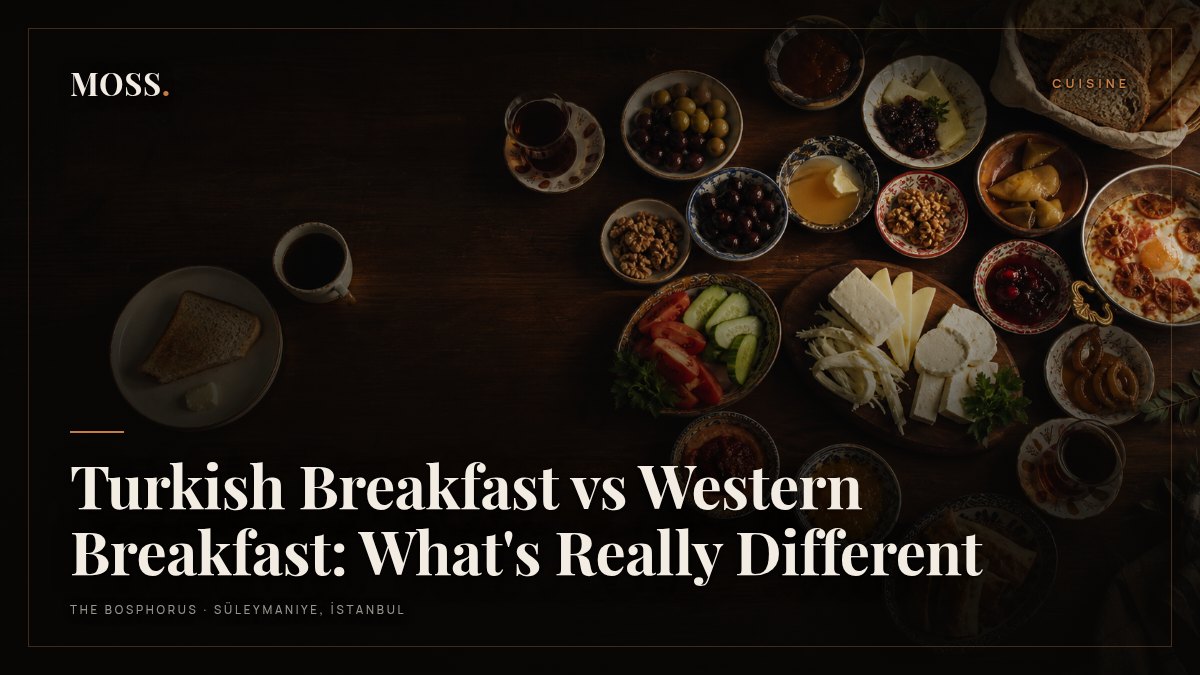
The difference between a Turkish breakfast and a Western breakfast comes down to one idea: a Turkish breakfast is a spread of many small dishes shared at once, while a Western or continental breakfast is usually a single plate eaten by one person. Where an English breakfast piles eggs, sausage and beans on one plate, and a continental one is a pastry and a coffee, a Turkish breakfast (in Turkish, “kahvaltı”) covers the table with cheeses, olives, eggs, jams, honey and bread, all out together, savoury and sweet side by side, with endless tea. It is less a meal you finish and more a table you settle into.
One plate, or the whole table?
The clearest difference is the shape of the meal. A Western breakfast tends to be portioned: your eggs, your toast, your bowl of cereal, served to you and eaten by you. A Turkish breakfast is the opposite. Dozens of small dishes arrive together and sit in the middle, and everyone reaches across and grazes from the same spread.
This changes how the meal feels. Nothing arrives in courses and nothing is really “yours”. You take a little of this, a little of that, return to what you liked, and keep going. The table looks generous before anyone has taken a bite, and the variety, rather than any single hero dish, is the point.
Savoury and sweet, at the same time
In much of the West, sweet and savoury breakfasts are separate choices: you have the pancakes, or you have the bacon and eggs. A Turkish breakfast refuses to choose. Salty white cheese sits next to runny honey, olives next to cherry jam, eggs next to a sweet pastry, and you move between them in the same sitting.
A typical spread runs across both registers at once:
- Savoury: beyaz peynir (white cheese), aged kaşar, olives, tomato and cucumber, eggs, often sucuk (spiced sausage) or börek (filled pastry).
- Sweet: honey, often poured over kaymak (thick clotted cream), alongside jams of cherry, fig, rose and apricot.
- The bridge: warm bread, which you tear and top with whichever side you fancy, switching from salty to sweet and back.
Alternating between the two across the meal is normal, and a salty-then-sweet bite is half the pleasure of the table.
Tea, not coffee, runs the table
In most of the West, coffee is the morning drink, the thing that gets you going. In Turkey, breakfast belongs to çay (Turkish black tea), brewed strong, served in small tulip-shaped glasses, and refilled again and again throughout the meal. Tea is the constant companion, the thing that ties the whole table together and keeps the morning moving.
Turkish coffee does exist and is loved, but it tends to come later, after the meal rather than during it. This catches many visitors out: at a Turkish breakfast, the glass that keeps being topped up is tea, and waving away the refills tends to end the ritual early. The pot almost always comes around again.
Fast fuel, or a slow ritual?
Perhaps the deepest difference is pace. A Western weekday breakfast is often quick, sometimes eaten standing or on a commute, built to fuel the day and be done. A Turkish breakfast, especially at the weekend, is the reverse. It is slow by design, with no single main to rush toward and no set order to follow, and people sit for an hour or two, talking between bites and refilling tea.
This is the heart of it. The meal is the occasion, not the fuel. At weekends, families gather for a leisurely serpme kahvaltı (a “scattered” breakfast where small plates cover every inch of the table) and let the morning stretch. If you want the full picture of how that table is laid and eaten, our guide to the traditional Turkish breakfast goes through it dish by dish.
What about the eggs?
Eggs sit very differently in each tradition. In a Western breakfast they are often the centrepiece, the main event the rest of the plate supports. In a Turkish breakfast they are one dish among many, frequently served as menemen, a soft scramble of eggs cooked with tomato and green pepper in a small pan, scooped with bread rather than eaten as a standalone main.
That demotion is telling. Nothing on a Turkish breakfast table is meant to dominate. The eggs join the cheeses, the olives, the honey and the bread as equal parts of a wider whole, and you graze across all of it rather than working through one main plate. The balance, not the centrepiece, is what defines the meal.
Where the difference is easiest to feel
If you would like to feel the difference for yourself, Moss Lounge the Bosphorus sits in Süleymaniye, on the historic peninsula, with a terrace over the old city and the water. Adem Özen, who opened it in 2019, lays out a generous Turkish breakfast and keeps the tea coming, running the place as a home rather than a restaurant. It is an easy place to settle in, taste a little of everything, and let a long Istanbul morning unfold at its own pace.