A Guide to Turkish Cheeses on the Breakfast Table
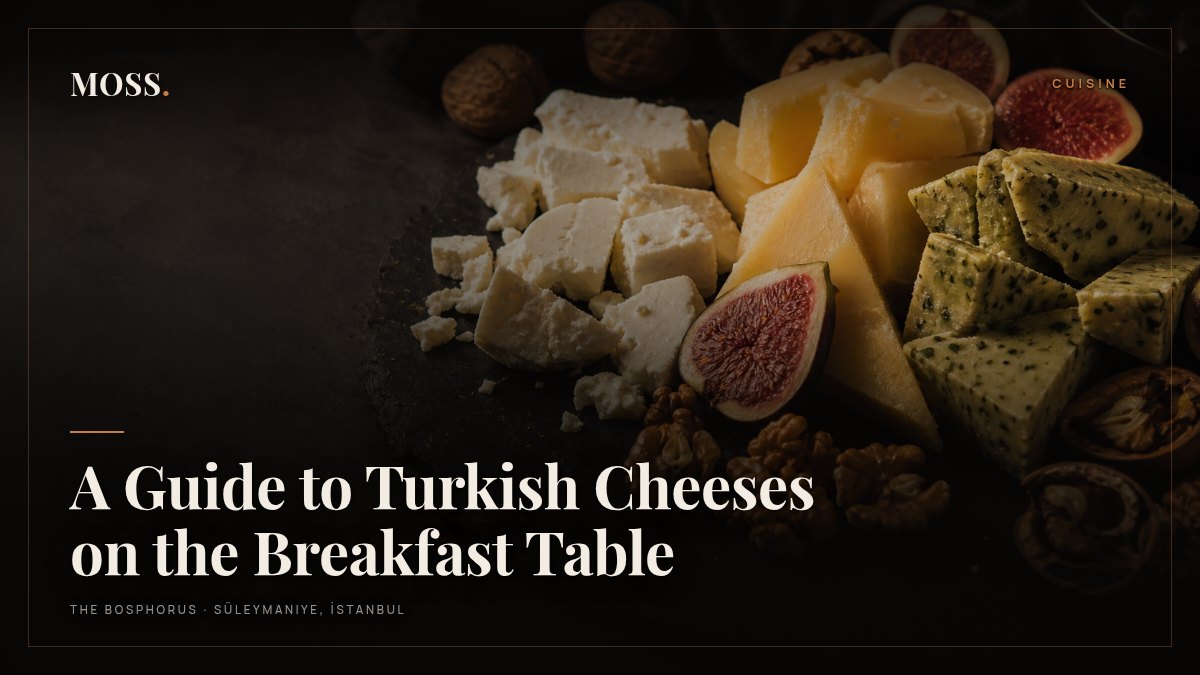
The cheeses on a Turkish breakfast table are not one thing but a small collection, set out in bowls and on boards to be grazed across through the meal. People ask what cheese is served at a Turkish breakfast, and the short answer is a spread of them: beyaz peynir (soft white cheese), kaşar (a firm mild yellow cheese), and often a sharper aged cheese alongside. They are eaten with bread, olives, honey and tomato, never as a single course, and the variety is half the pleasure.
Which Turkish cheeses appear at breakfast?
A good breakfast board usually holds two or three cheeses chosen to play off one another: something soft and salty, something firm and mild, and sometimes something aged and pungent for contrast. The cast varies by region and by season, but a few names come up again and again across Istanbul tables.
- Beyaz peynir: the cornerstone. A soft, brined white cheese close to feta, salty and a little crumbly, made from sheep, goat or cow milk. It is the cheese most people picture when they think of a Turkish breakfast.
- Kaşar: a firm, pale yellow cheese, mild and gently nutty, sliceable and easy to like. Younger kaşar is soft and milky; aged eski kaşar turns harder and sharper.
- Tulum: a crumbly, tangy cheese traditionally aged in a goatskin (the tulum it is named for). Stronger and saltier, it rewards a small piece on bread.
- Örgü peyniri: braided string cheese, mild and salty, pulled apart into threads. Children love it, and so does anyone who likes to play with their food a little.
- Mihaliç: a firm sheep-milk cheese from the Bursa region, salty and full-flavoured, sometimes grilled. It holds its own next to strong olives and tea.
What does each Turkish cheese taste like?
The pleasure of the board is in the range. Beyaz peynir brings the salt and the soft, cooling texture that balances richer dishes. Kaşar is the gentle one, the cheese you reach for when you want mild and buttery rather than sharp. Tulum and aged kaşar sit at the bold end, tangy and assertive, best in small bites that wake up the palate between milder ones.
Texture matters as much as flavour. Some cheeses crumble, some slice clean, some pull into strings. A well-set table gives you a little of each, so a single mouthful of bread can carry soft and firm at once. None of it is fussy. It is honest dairy, made to be eaten without fuss.
How do Turkish cheeses sit on the table?
The cheeses are part of a wider spread, set out at the same time as everything else rather than served in courses. They share the table with bowls of olives, sliced tomato and cucumber, eggs, warm bread, and the sweet things: honey, jam and butter. Nothing waits its turn. You build each bite yourself from whatever is in front of you.
This is what makes the cheese board feel generous rather than precious. A wedge of beyaz peynir next to a spoon of honey, a slice of kaşar folded into bread, a crumble of tulum chased with a strong olive: the table is built for these small combinations. If you want the wider picture of how the whole spread works, our guide to the traditional Turkish breakfast walks through every dish and the unhurried way it is eaten.
How to pair Turkish cheeses with the rest of the table
The cheeses are at their best in combination, salty against sweet, soft against firm. A few pairings earn their place at almost every breakfast:
- Cheese and honey: salty beyaz peynir with runny honey is a classic, the savoury-sweet bite that defines the table.
- Cheese and olives: green and black olives cut the richness and add a briny edge that suits the firmer cheeses.
- Cheese and tomato: fresh sliced tomato lifts a salty white cheese and keeps each bite light.
- Cheese and bread: warm bread is the base for all of it, soft cheese spread on, firm cheese folded in.
- Cheese and çay: a glass of strong tea between bites resets the palate for the next cheese.
Tea is the constant alongside all of this. A glass of çay (Turkish black tea), refilled through the meal, ties the salty cheeses and sweet honey together, and our guide to Turkish çay covers why it is poured endlessly at breakfast.
A breakfast board in Süleymaniye
If you would like to graze a proper cheese board the slow way, Moss Lounge the Bosphorus sits in Süleymaniye, on the historic peninsula, with a terrace over the old city and the Bosphorus. Adem Özen, who opened it in 2019, lays out a generous Turkish breakfast and keeps the tea coming, running the place as a home rather than a restaurant. It is a calm corner to work your way across white cheese, honey and warm bread while the morning light moves over the water.