The Spice Bazaar: A Visitor's Guide to Mısır Çarşısı
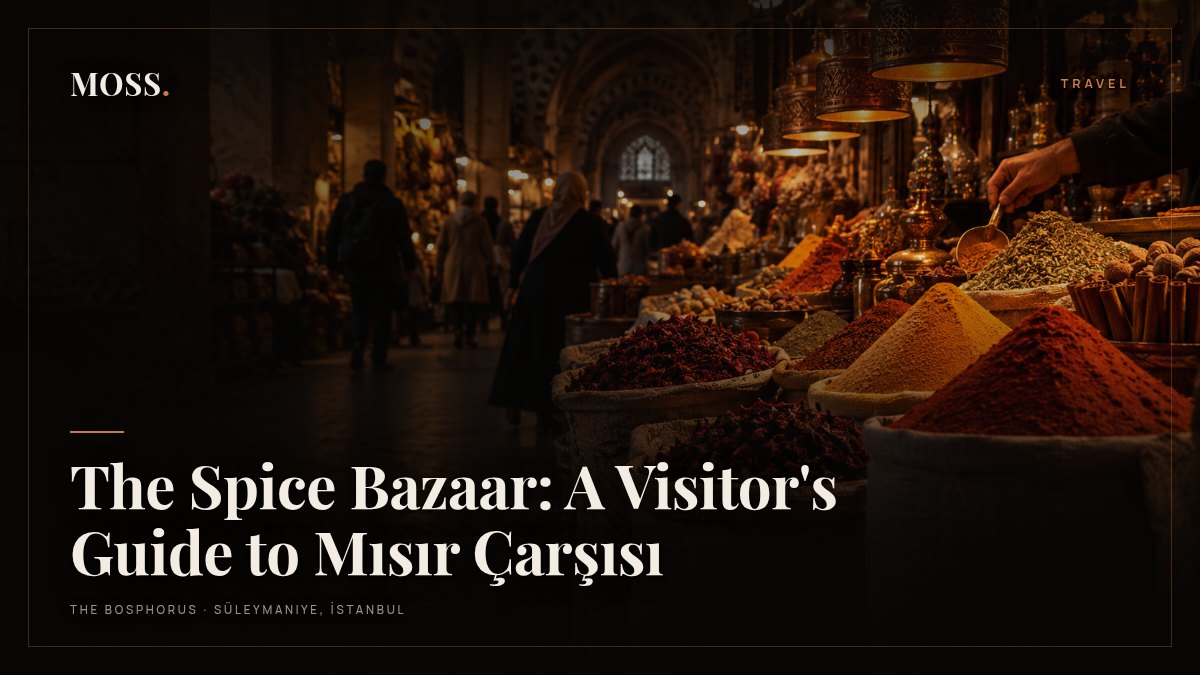
The Spice Bazaar in Istanbul, known in Turkish as Mısır Çarşısı (the Egyptian Bazaar), is a covered market at Eminönü, on the Golden Horn, where traders have sold spices, dried fruit, nuts, tea and Turkish delight since the 1660s. It is smaller and easier to take in than the Grand Bazaar, and it sits at the foot of the hill that climbs to Süleymaniye, which makes it a natural start to an afternoon in the old city.
What is the history of the Spice Bazaar?
The bazaar was built as part of the Yeni Cami, the New Mosque complex at Eminönü. The mosque was begun in the 1590s and finally completed in 1665 under the patronage of Turhan Hatice Sultan, mother of Sultan Mehmed IV. The market's rents helped pay for the mosque's upkeep, the usual Ottoman arrangement in which commerce funded a religious foundation.
The name “Egyptian” is usually traced to its early trade and funding: goods arriving from Cairo, and revenues from the Ottoman province of Egypt. Spices, coffee, henna and medicinal herbs came up the sea routes and were sold here, and for centuries the bazaar doubled as the city's pharmacy, with herbalists mixing remedies alongside the cooks' supplies. The L-shaped hall, with its vaulted ceiling and heavy stone gates, has been restored several times but keeps its seventeenth-century bones.
What should you buy at the Spice Bazaar?
The best buys are the things Turkish kitchens use every day, bought fresh and in modest amounts. Look for:
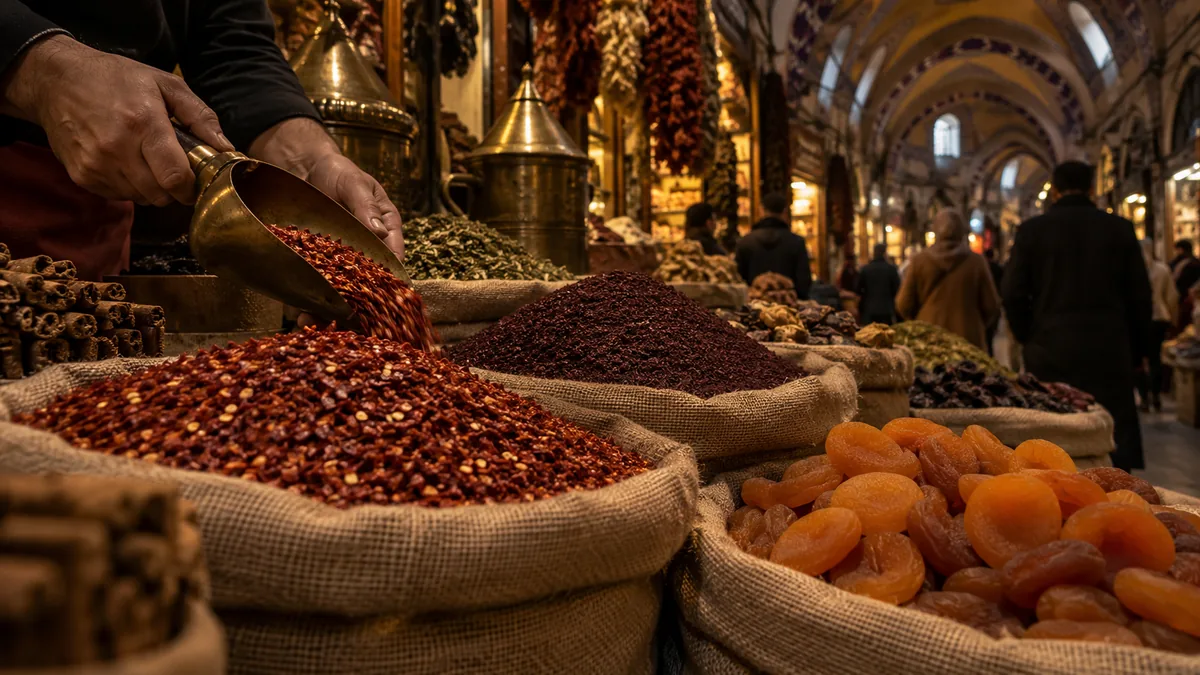
- Spices: pul biber (mild red pepper flakes), isot (the smoky, almost black Urfa pepper), sumac, dried mint and oregano. These are the real flavours of the Turkish table.
- Lokum: Turkish delight, ideally plain rose, pistachio, or the firmer kind packed with nuts. Ask to taste before you buy.
- Dried fruit and nuts: apricots from Malatya, figs, white mulberries and Antep pistachios.
- Tea: Turkish black tea from the Black Sea coast, plus dried linden or sage for herbal infusions.
- Coffee: finely ground Turkish coffee, which loses its aroma quickly, so buy small packs.
Most shops will vacuum-pack spices and lokum for travel, which keeps them fresh in a suitcase. Ask for it.
How do you avoid tourist-priced stalls?
The stalls nearest the main gates tend to charge the most and lean hardest on the colourful pyramids of “sultan's mix” and “love tea” that look wonderful in photographs and taste of very little. A few rules help:
- Buy by weight from open sacks or jars rather than pre-packed gift boxes, and ask the price per kilo before anything is scooped.
- Be wary of cheap “saffron”. Real saffron is expensive everywhere; a bargain is usually safflower.
- Taste first. Good traders will offer without being asked.
- Walk the side streets outside the hall, where many shops sell the same goods to Istanbul cooks at everyday prices.
Bargaining is lighter than its reputation. Many shops have fixed prices per kilo; where they do not, a polite request for a better price on a larger order is normal, and haggling hard over a small bag of pepper is not.
What is around the Spice Bazaar?
The streets around the bazaar, known together as Tahtakale, are where the working market lives. This is a wholesale quarter: sacks of beans and rice, kitchen supplies, cheap toys, counters of cheese and pastırma (air-dried cured beef), and porters bent under loads that look impossible. On the corner behind the bazaar, a queue forms outside Kurukahveci Mehmet Efendi, the coffee roaster that has been grinding beans here since the nineteenth century, and the smell carries down the street.
Just to the west, above a row of shops, the Rüstem Paşa Mosque is one of Mimar Sinan's smaller works and one of his loveliest, lined inside with İznik tiles in blues, greens and coral red. It is easy to walk past the narrow staircase that leads up to it, so look out for it.
How do you walk from the Spice Bazaar to Süleymaniye?
From Tahtakale, follow Uzunçarşı Caddesi, the long market street that climbs uphill, or any of the lanes rising to the west of it. Within twenty minutes the traffic thins, the shops give way to old stone medreses, and the Süleymaniye Mosque appears above you. It is a steep walk, so take it slowly. If you want to fold in the Grand Bazaar as well, our route from the Grand Bazaar to Süleymaniye connects the two, and once you arrive, our guide to the Süleymaniye Mosque covers what to see inside.
Go in the morning or late afternoon. Midday and Saturdays are the busiest times, when the hall can feel more like a crush than a market.
After the bazaar, a table on the hill
At the top of the climb, Moss Lounge the Bosphorus sits on Fetva Yokuşu in Süleymaniye, a rooftop terrace with the Süleymaniye Mosque on one side and the Golden Horn and Bosphorus on the other. After an afternoon of spice sacks and coffee queues, it is a calm place to sit with endless çay, a signature dessert or a nargile (Turkish water pipe), while Adem Özen, the host, looks after you as though you had come to his home. Reservations are by WhatsApp.